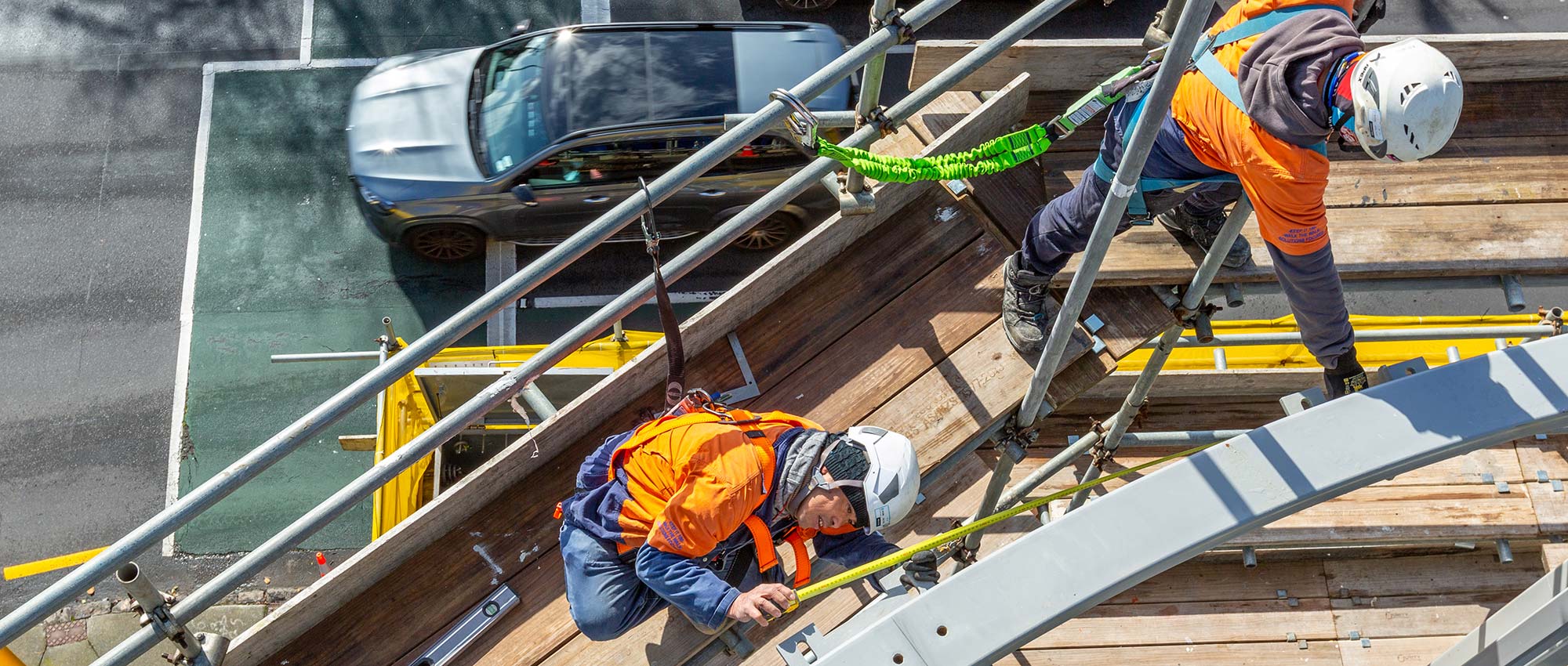
Accidents happen, but some accidents have more serious consequences than others. With this in mind, Cassidy Construction has rebuilt its health and safety strategy from the ground up, with an emphasis on daily frontline engagement and focussing on high-energy hazards that can kill or seriously injure.
Health, Safety and Environment Manager Susy Pryde and her team spearheaded the project, which is based on the work of the Construction Safety Research Alliance at the University of Colorado Boulder relating to High-Energy Hazard Control Assessments (HECA), but tailored for the Cassidy Construction environment.
‘It’s about limiting our people’s exposure to the stuff that’s going to kill them,’ Susy says. ‘The feedback we were receiving from our teams was that the importance of managing major life-threatening hazards had been watered down by endless risk matrices for small things like slips and trips that would only ever result in minor injury.
‘We wanted to prevent serious injuries or fatalities by swinging the focus towards high-energy hazards that pose significant risks in construction environments. Rather than focusing on how things have gone wrong in the past, we worked to better understand why things go right and how we could create conditions in which success is more likely.’
According to the NZ Institute of Safety Management, a high-energy hazard is one with a force of 1500 joules or more – enough to result in a serious injury or fatality – whereas an accident involving 500 joules of energy is likely to cause only a first-aid injury.
Susy and her team identified 15 areas of Cassidy’s work where hazards have the potential to seriously hurt or kill, and formulated and rolled out a new Energy-Based Safety regime that helps our people focus on the most important safety risks – the Stuff That Kills You (STKY).
‘It has been integrated into our daily practice and has been supported from the boardroom to the front line. As a result, our people are more involved and engaged in identifying hazards and ensuring that direct or acceptable alternative controls are in place. They are better at understanding the potential of hazards on the fly, and more confidently take ownership of controlling them.’
Susy says the new approach has been supported by Construction Health and Safety New Zealand and was selected as a finalist in the 2025 New Zealand Workplace Health and Safety Awards, which draws entries from some of the country’s biggest companies and public sector employers.
She supports an industry shift to focus on implementation of safeguards, as opposed to post-incident event gaps, and has been invited to share Cassidy’s learnings with others in the construction industry. ‘Energy-based safety is a new, proactive approach that we hope others in the industry will learn from and adapt to suit their own needs.
‘The concept of high-energy hazards has motivated us to step up our game in terms of how we relate to our people on critical risk, as well as create systems to measure, improve and report on which tasks and sites are truly safeguarded. Critical risk management is in plain sight.’
Find out more about our approach to Health & Safety here.